
Top 10 High Flow Filter Cartridges for Industrial Use?
Industrial filtration rarely fails because a cartridge looks inadequate. It fails when flow, pressure, temperature, and fluid chemistry are poorly matched. High Flow Filter Cartridges are designed for demanding systems that process large liquid volumes without expanding the vessel footprint. Their value becomes visible at the pump discharge, where pressure stability, service life, and consistent particle removal directly affect production.
Filtration author Dr. Nicholas P. Cheremisinoff has emphasized, “Filtration performance depends on the process conditions surrounding the filter.” That principle guides this review. The best cartridge is not automatically the one with the finest micron rating. It must also suit viscosity, contaminant loading, seal materials, connection style, and cleaning practices. Small details matter.
A clear comparison helps.
This “Top 10” guide examines High Flow Filter Cartridges used in water treatment, chemicals, food processing, coatings, and industrial manufacturing. Each option should be judged against real operating evidence, including differential-pressure trends, cartridge replacement intervals, and verified flow data. Manufacturer claims can look impressive. Field performance may tell a different story.
The ranking is not absolute. A cartridge that performs well in cooling water may struggle with oil, polymers, or abrasive solids. That limitation deserves attention. Some selection decisions also remain uncertain without pilot testing or a complete fluid analysis. Readers should treat this guide as a practical starting point, not a substitute for engineering validation. Expect useful comparisons, but leave room for revision when plant conditions challenge the specifications.
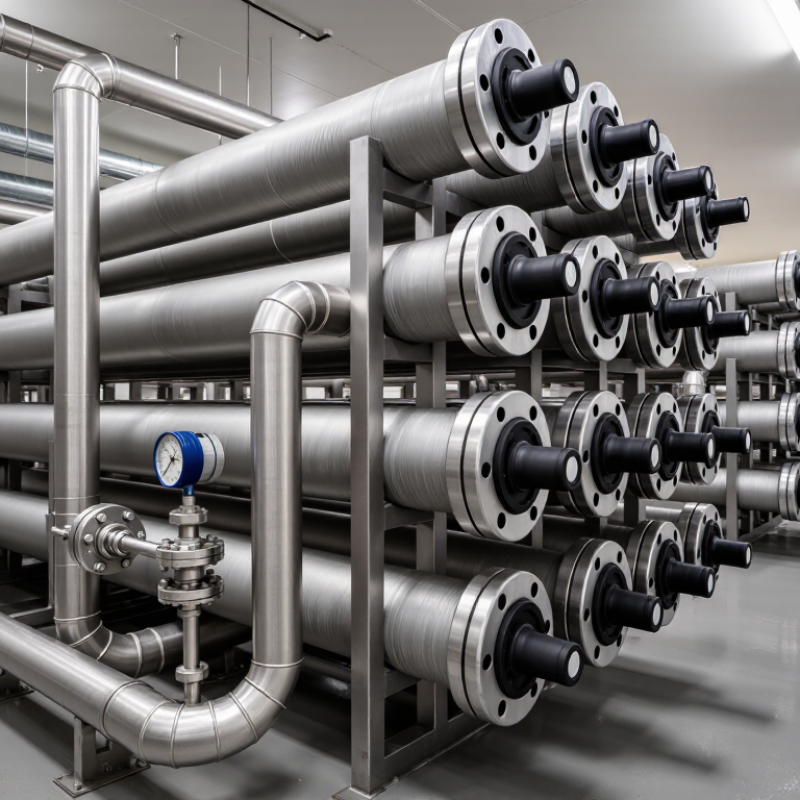
What Are High Flow Filter Cartridges and How Do They Work?
High flow filter cartridges are designed to process large water or process-fluid volumes with fewer elements than conventional cartridges. Their wide, pleated media provides a larger filtration area. Fluid usually enters from the outside and moves toward the core, while trapped particles remain in the media layers. Cleaned fluid then exits through the central channel.
In industrial service, operators often select these cartridges for cooling water, pretreatment, process water, and chemical filtration. Flow capacity depends on pore rating, fluid viscosity, temperature, and contaminant loading. A cartridge rated at 5 microns may behave differently in oily liquid than in clear water. Pressure gauges tell the real story. Rising differential pressure indicates that the media is filling with solids.
Practical selection involves more than comparing flow numbers. Check the seal material, housing compatibility, operating pressure, and cleaning requirements. A high dirt-holding capacity can extend service life, but it may also hide gradual performance changes. During commissioning, measure pressure before and after filtration. Record the readings under normal flow. Small details matter.
No cartridge fits every plant. A perfect rating on paper can still disappoint. I have seen oversized elements run inefficiently because the feed pump was unstable. In other cases, a finer medium reduced downstream contamination but caused frequent replacement. Reviewing actual water quality, seasonal changes, and maintenance records leads to a more dependable choice. Testing remains worthwhile.
Top 10 High Flow Filter Cartridges for Industrial Use? - What Are High Flow Filter Cartridges and How Do They Work?
| Rank | High-Flow Cartridge Type | How It Works | Common Filter Media | Typical Rating | Typical Clean-Water Flow* | Common Lengths | Typical Industrial Applications | Main Advantage |
|---|---|---|---|---|---|---|---|---|
| 1 | Pleated High-Flow Cartridge | A large pleated surface area captures suspended solids as liquid passes from the outside of the cartridge toward the core. | Polypropylene, polyester, or glass fiber | 1–100 μm nominal; selected grades available as absolute-rated | 20–80 m³/h | 20, 40, 60 in | Cooling water, process water, pretreatment, paints, coatings, and general liquid clarification | High dirt-holding capacity with relatively low initial pressure drop |
| 2 | Melt-Blown Depth Cartridge | A graded, nonwoven depth structure traps particles throughout the thickness of the cartridge rather than only at the surface. | Polypropylene microfibers | 1–100 μm nominal | 8–35 m³/h | 20, 40, 60 in | Pre-filtration, water treatment, chemical solutions, and protection of downstream membranes | Economical particle removal and broad chemical compatibility |
| 3 | High-Flow Melt-Blown Depth Cartridge with Graded Density | Coarser outer layers retain larger particles while finer inner layers capture smaller particles, increasing usable dirt capacity. | Polypropylene | 5–50 μm nominal | 15–50 m³/h | 40, 60 in | High-solids process water, surface water, wastewater polishing, and industrial pretreatment | Improved solids loading compared with uniform-density depth media |
| 4 | High-Flow Absolute-Rated Cartridge | A controlled pore structure provides a defined particle-retention level, often verified by standardized efficiency testing. | Polypropylene membrane or fine glass fiber | 0.5–20 μm absolute, depending on test method | 5–30 m³/h | 20, 40, 60 in | Fine chemical filtration, high-purity water, electronics process water, and critical final filtration | More predictable particle retention than nominal-rated media |
| 5 | Pleated Membrane High-Flow Cartridge | A microporous membrane forms a fine barrier; the pleated design increases effective filtration area within a compact housing. | Polyethersulfone, polypropylene, or PTFE | 0.1–10 μm absolute, depending on membrane | 3–25 m³/h | 20, 30, 40 in | Pharmaceutical liquids, beverage filtration, sterile-process support, and high-purity chemicals | Fine and consistent filtration with high particle-removal efficiency |
| 6 | String-Wound High-Flow Cartridge | A fiber strand is wound around a core with controlled gaps, creating a depth-filtration path for suspended solids. | Polypropylene, cotton, or treated fibers | 1–100 μm nominal | 6–25 m³/h | 20, 40, 60 in | Viscous liquids, water with variable particle sizes, oils, solvents, and general process filtration | Flexible pore structure and effective depth loading |
| 7 | Pleated Polyester High-Flow Cartridge | A reusable or disposable polyester medium captures particles on and within pleats; some designs can be cleaned and reused. | Polyester felt or polyester membrane | 1–75 μm nominal | 15–60 m³/h | 20, 40, 60 in | Industrial cooling systems, metalworking fluids, wash water, and applications requiring dimensional stability | Good mechanical strength and resistance to repeated flow cycles |
| 8 | High-Flow Activated Carbon Cartridge | Activated carbon adsorbs dissolved organic compounds, chlorine, taste- and odor-causing substances; a prefilter is often recommended for solids. | Granular activated carbon or carbon block | Usually 5–50 μm for combined particle designs | 5–25 m³/h | 20, 40, 60 in | Process-water dechlorination, wastewater odor control, food processing, and organic contaminant reduction | Removes selected dissolved contaminants that particulate filters cannot capture |
| 9 | High-Temperature Glass-Fiber Cartridge | Fine glass fibers form a dense depth medium that retains small particles while tolerating temperatures higher than many polymeric media. | Borosilicate glass fiber | 0.5–50 μm nominal or absolute, depending on construction | 5–25 m³/h | 20, 30, 40 in | Hot process liquids, hydraulic fluids, solvents, and applications requiring fine particle control | High-temperature capability and fine particle retention |
| 10 | Washable Metal-Mesh High-Flow Cartridge | A precisely sized metal mesh retains particles at the surface and can often be cleaned by backwashing, flushing, or ultrasonic methods. | Stainless steel or nickel-alloy mesh | 10–200 μm nominal | 20–100 m³/h | 20, 40, 60 in | Hydraulic oil, hot liquids, cooling-water loops, metalworking fluids, and reusable industrial filtration | Reusable construction and strong resistance to high temperature and pressure |